|
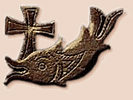
Ichtys
(ἰχθύς)
Greek. “Fish”. It is one of the initial symbols of
Christianity,
used
by the earliest followers of
Jesus of Nazareth, among a
wide
variety of other symbols to express their faith, including a dove, a
ship, a lyre, an anchor, a cross, a lamb, a shepherd and the Greek
letters chi (Χ)
and rho (ρ),
an abbreviation
for Christ often used as a
monogram.
Ichtys is an acronym for
“Iesous Christos Theou Uios Soter” (Ἰησοῦς
Χριστός θεοῦ Υἱός Σωτήρ), meaning
“Jesus Christ, Son of God, Saviour”.
The
name Jesus derives from the Greek Iesous (Ἰησοῦς), a
Hellenisation of the Hebrew-Aramaic names Yeshua (ישוע) and
Yehoshua (יהושע), both
meaning “Yahweh
(God)
rescues”, whereas Christ is a
title that derives from the Greek word Christos (Χριστός),
meaning the “Anointed One”, which corresponds to the
Hebrew-Aramaic word Messiah (משיחא).
Both the name Jesus and Ichtys thus refer
to salvation. In some cases fish may perhaps be interpreted metaphorically,
as a symbol of the righteous and righteousness, i.e. “What man
is there of you whom if his son ask a fish, will he give him a serpent?”. Tertullianus, a Christian theologian writing at beginning of the 3rd
century, interpreted the Ichtys symbol as one of baptism: “But we small
fishes, named after our great Ichtys, Jesus Christ, are born in water
and only by remaining in water can we live”. Also transcribed ichtus.

Ishmael (יִשְׁמָעֵאל)
Name of the first son of Abraham and Hagar, Sarah’s Egyptian
maidservant. In Hebrew, his name is pronounced Yishmaʿel (יִשְׁמָעֵאל),
meaning “God has hearkened”, suggesting that he was regarded as the
fulfillment of a divine promise. Born as a result of Sarah’s initial
barrenness, Ishmael’s birth is narrated in
Genesis 16, where God hears Hagar’s
distress and promises that her son will become the progenitor of a great
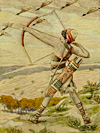
nation. According to biblical accounts, Ishmael is blessed by God, grows
to become a skilled archer, and fathers twelve sons who become the
chiefs of twelve tribes, traditionally associated with the peoples of
the Arabian Peninsula (Gen.
25:12–18). While Ishmael is distinct from Isaac, Abraham’s
son with Sarah and the ancestor of the Israelites, he remains part of
the covenantal narrative, receiving divine promises regarding his
descendants. In later Jewish, Christian, and Islamic traditions, Ishmael
is seen as the patriarch of the
Ishmaelites or
Arab peoples, and in Islamic theology, he is also regarded as an
important figure in the lineage leading to the Prophet Muhammad. In
Genesis 16:12, Ishmael is described as
pēred ’īsh (פֶּרֶד אִישׁ), “a wild donkey of a man,” with the text
stating that “his hand will be against everyone, and everyone’s hand
against him, and he will live in hostility toward all his brothers.” The
imagery of the “wild donkey” has been interpreted in multiple ways. On
one hand, it may symbolise independence, freedom, and untamed strength,
reflecting both the challenges and resilience of Ishmael’s character and
the nomadic lifestyle traditionally associated with his descendants,
often linked to the tribes of the Arabian Peninsula. On the other hand,
the description has also been read as emblematic of conflict and
adversarial relationships arising within a tribal context, suggesting
enduring tensions between Ishmael’s lineage and other peoples. The
phrase situates Ishmael within the broader Abrahamic narrative,
highlighting both his separation from Isaac—the child of the
covenant—and the enduring significance of his lineage in biblical and
later religious traditions. In the
New Testament,
the Apostle Paul refers to Ishmael in
Galatians 4:21–31 to illustrate a
theological allegory contrasting the “child of the flesh” with the
“child of the promise.” Drawing on the Genesis narratives of Hagar and
Sarah, Paul presents Ishmael, Abraham’s son by Hagar, as a symbol of
bondage and reliance on human effort, in contrast to Isaac, Abraham’s
son by Sarah, who represents divine promise and freedom. Paul interprets
the conflict between Ishmael and Isaac typologically, associating
Ishmael with the old covenant and worldly concerns, and Isaac with the
covenant of God and the new spiritual freedom offered through
Christ.
In this way, Ishmael is not only a historical figure but also an
allegorical representation of human dependence on the flesh versus trust
in divine providence. By invoking Ishmael’s story, Paul underscores
themes of covenant, promise, and the distinction between spiritual
slavery and freedom, linking the Abrahamic narrative to the broader
theological framework of salvation in
Christ.
Ishmaelite
An
Ishmaelite is a descendant of
Ishmael,
the first son of Abraham and Hagar, and Ishmaelites are traditionally
regarded as the ancestors of many Arab peoples. According to
Genesis 25:12–18,
Ishmael
had twelve sons who became the heads of twelve tribes, settling in the
region from Havilah to Shur, near Egypt and extending toward Assyria. In
the Hebrew Bible, the Ishmaelites are depicted as a nomadic,
desert-dwelling people, organized into clans and tribes, moving
seasonally in search of grazing land and water. Their familiarity with
desert routes enabled them to engage in long-distance trade and caravan
travel, facilitating the exchange of goods and culture across the
ancient Near East. They are notably mentioned in
Gen. 37:25, where a caravan of
Ishmaelites buys Joseph from his brothers and transports him to Egypt,
demonstrating their role as merchants and intermediaries within regional
commerce. Historically and culturally, the Ishmaelites contributed to
the broader network of nomadic trade, and their ancestral connection to
Abraham links them to the covenantal narratives of Israel, though they
remained distinct from the settled Israelites. In later traditions,
particularly within Islamic thought,
Ishmael
is recognized as a prophet and progenitor of Arab peoples, reinforcing
the identification of the Ishmaelites with Arab tribes and highlighting
their enduring significance in the genealogical and cultural history of
the Near East.
|